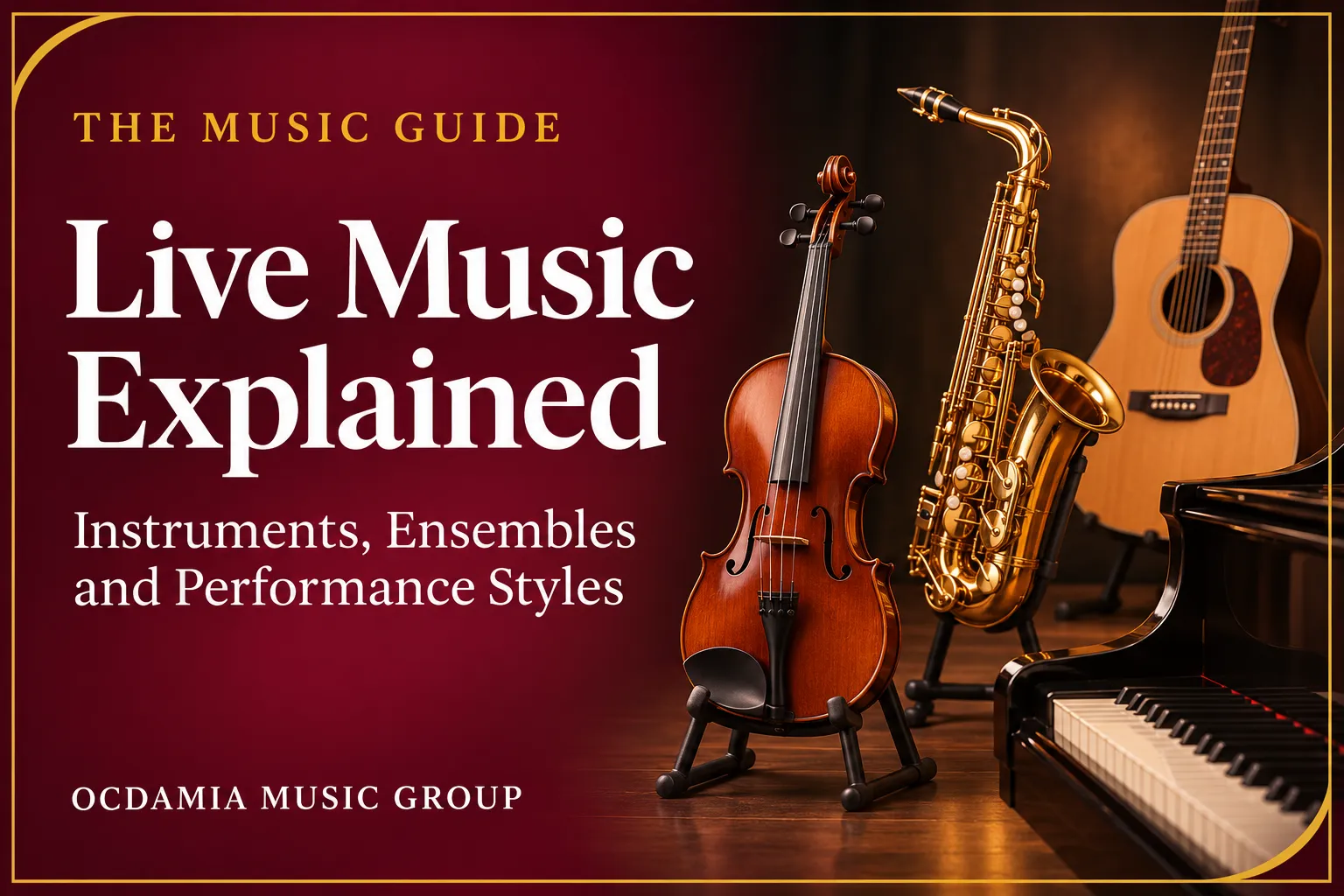
Live Music Explained: Instruments, Ensembles and Performance Styles
Written by Margie Ocdamia
Live music explained in simple terms starts with three details:
the instruments you hear, how the musicians share the musical parts,
and how the sound is produced and supported.
You recognize the song, but the sound is different. A violin carries
the melody instead of a singer, a guitarist supplies the accompaniment,
or a small ensemble turns a pop recording into an instrumental piece.
This guide explores instruments, ensemble sizes, arrangements and
performance styles, with solo, duo and quartet examples to help you
describe what you enjoy without needing a musical background.
What Counts as Live Music?
Live music includes a musical contribution performed
in real time, such as singing, playing an instrument
or creating musical layers during a performance.
A performance can combine live playing with recorded
accompaniment. A saxophonist might play over a prepared
instrumental track. A guitarist might capture a phrase
with a loop pedal and play another part over its
repeating playback.
Amplification is a separate detail. Hearing an instrument
through speakers does not mean its part is prerecorded.
Our guide to
live music vs. backing tracks
explains recorded accompaniment, looping and the questions
to ask about a performance setup.
Four Details That Shape What You Hear
Different types of live music are easier to compare
when you separate instrumentation, ensemble size,
arrangement and performance setup.
If the full table does not fit your screen, scroll it horizontally.
Understanding the sound beyond the song title
Detail
What it describes
Example
Instrumentation
The instruments and voices involved
Violin and cello, guitar and vocals, or saxophone and piano
Ensemble size
The number of performers
Soloist, duo, trio, quartet or larger group
Arrangement
How musical parts are assigned and adapted
A violin taking the vocal melody of a pop song
Performance setup
How sound is supported and delivered
Microphones, speakers, backing tracks or looping
These elements work together. Two duos can sound
different because they use different instruments,
arrangements or accompaniment.
Understanding the Instruments
Words such as bright, warm, rounded and airy describe
qualities of tone. Playing technique, musical range
and recording conditions also influence an
instrument's sound.
Violin, viola and cello belong to the bowed string
family. Players can sustain notes with a bow or
pluck the strings for a different effect.
Of these three instruments, the violin generally
occupies the highest range, followed by viola and
cello. Their ranges overlap, and any of them
can carry a melody.
In an ensemble, their roles can change. A cello may
provide a lower supporting line in one passage
and take the melody in another.
Guitar
A guitarist can play a melody, strum chords, pick
accompanying patterns or combine several musical roles.
A solo fingerstyle arrangement can sound quite different
from a singer accompanying themselves with strummed
chords. The technique changes how melody, harmony
and rhythm fit together.
Piano and Keyboard
A pianist can combine melody, harmony and lower
accompaniment within one performance.
An acoustic piano produces sound through strings
struck by hammers. A digital keyboard produces
sound electronically and may offer piano sounds
alongside other instrument tones.
Yamaha's
piano guide
explains how the acoustic instrument's mechanism works.
Hearing several musical parts does not necessarily
mean there are several players or a backing track.
One keyboard player can perform multiple parts.
Harp
A harpist plucks strings and can combine melodic
lines with accompanying patterns or chords.
Tempo, articulation and arrangement can change its
character. Harp music can be delicate, rhythmic
or dramatic, depending on the piece and interpretation.
Saxophone
The saxophone is a reed instrument in the woodwind
family, despite its metal body.
Its sound can be smooth, breathy, bright or forceful,
depending on the player and musical approach.
Saxophonists perform in jazz, classical, pop,
soul and other styles.
Voice
A singer's phrasing, tone, range and interpretation
can change the character of a familiar song.
Dynamics are the changes in loudness and intensity
that help shape that delivery.
The accompaniment matters too. Voice with guitar
offers a different texture from voice with piano,
a band or recorded instrumental backing.
What Do Solo, Duo, Trio and Quartet Mean?
Live music ensembles can range from a duo to a
large orchestra. Solo, duo, trio and quartet
describe the number of performers rather than
the instruments or musical genre.
Scroll horizontally if needed to view the full comparison.
Performer numbers and possible lineups
Format
Number of performers
Possible example
Solo
1
Guitarist, pianist, violinist or vocalist
Duo
2
Violin and cello, or a guitarist and a separate vocalist
Trio
3
Three string players or a jazz combination
Quartet
4
Traditional string quartet or another four-person lineup
Larger ensemble
More than 4
A five-piece band, larger chamber ensemble or orchestra
A traditional string quartet usually includes two
violins, viola and cello. Other groups use different
combinations, so confirm the lineup. The word
“band” does not specify a fixed number of players.
More performers create opportunities for additional
independent parts. An arrangement may also have
musicians playing the same line together, known
as playing in unison.
Acoustic and Electric Instruments: What's the Difference?
Acoustic instruments project sound through physical
vibration and resonance. Electric string instruments
use pickups to convert string vibrations into an
electrical signal that can be amplified.
An acoustic instrument can also use a microphone
or pickup to send its sound through speakers.
Amplifying it does not turn its musical part
into a recording.
Electronic instruments, such as synthesizers, can
generate sound electronically. Digital instruments
may also use recorded samples. Playing individual
sampled notes from a keyboard in real time differs
from playing a prepared accompaniment track.
“Acoustic” does not necessarily mean unamplified,
and “electric” does not mean prerecorded.
To understand a setup, ask:
Is the instrument acoustic, electric or electronic?
Is the live sound amplified?
Are effects changing the tone?
Is recorded accompaniment included?
How Does an Arrangement Change a Song?
An arrangement adapts a piece of music for particular
performers and instruments. It determines how the
musical parts work together.
Imagine a song recorded with lead vocals, backing
harmonies, guitar, keyboards, bass and drums.
A violin-and-cello arrangement needs to adapt
that material for two instruments.
The violin might take the vocal melody while the
cello supplies a lower accompanying line. Some
harmonies may be simplified, rhythmic patterns
adapted and sections shortened where appropriate.
The song can remain recognizable without reproducing
every part of the original recording. These musical
terms help describe what is retained or changed:
Melody: the main tune you recognize.
Harmony: notes or chords supporting the tune.
Rhythm: patterns of notes and rests that organize movement in time.
Bass line: a lower musical line that can support the arrangement.
Texture: how the musical layers combine.
A sparse arrangement leaves space around individual
parts. A denser arrangement brings more layers
together. Either approach can suit a familiar song.
Genre, Arrangement and Performance Style Are Different
Classical, jazz, pop and soul describe musical
traditions or genres. These labels provide context
but do not fully describe an arrangement
or its delivery.
A pop song could become a string arrangement,
a jazz interpretation or a solo guitar piece.
Instrumentation, rhythm and phrasing give each
version a different character.
Live music performance styles also reflect how
musicians interpret and present the music,
including their interaction, dynamics and
stage movement.
Compare these two descriptions: “I like pop music”
identifies a broad preference. “I like a clear
instrumental melody with gentle rhythmic accompaniment”
explains more about the sound you enjoy.
How Should You Compare Performance Videos?
Compare similar material where possible and adjust
playback so the samples sound roughly equally loud.
This helps you assess the performance without
letting recording volume dominate your impression.
Microphone placement, room acoustics and mixing
affect the balance between instruments. A camera
may also leave performers outside the frame.
The video alone may not explain the complete
audio setup.
If the songs differ, compare the same musical
qualities: clarity of melody, supporting parts,
phrasing and changes in intensity. Use the
examples below to practice.
Listen to Solo Violin, Violin and Cello Duo, and String Quartet
These examples introduce three string formats.
Listen to each on its own terms: the songs,
arrangements and recording conditions may differ.
The lineup label does not establish whether
recorded accompaniment is included.
Solo Violin: Follow the Featured Line
Focus first on the violin. Can you follow the
melody through the phrase? Notice sustained
notes, shorter articulations and changes in
intensity. Then listen for any other audible
layers around the featured instrument.
Try following the cello before returning to the
violin. Does the lower part sustain notes,
establish a pulse or offer a melodic response?
Listen for how the two lines fit together
and whether their roles change.
Identify the main melody, then shift your attention
to the supporting parts. Can you hear sustained
harmony, rhythmic movement or another musical
line? Notice when the players move together
and when their parts become more independent.
After listening, complete this sentence:
“I preferred this performance because…”
Describe one musical detail, such as the
phrasing, instrumental tone or interaction
between parts.
How Does Understanding the Music Help You Choose Performers?
Use a sample you enjoy as a starting point,
then confirm the format behind it. A useful
comparison includes:
The actual instruments and number of performers
Whether vocals are included
Whether the arrangement uses backing tracks or looping
Whether your preferred songs suit that format
Whether the sample reflects the proposed performance
If you are moving from listening to planning,
our
guide to booking musicians
explains the practical information to prepare.
You do not need specialist vocabulary to explain
your preferences. Choose a performance, identify
one detail you enjoy and ask about its instruments,
arrangement and accompaniment.
Corporate holiday party music works best when it follows the evening's schedule. Welcome guests with music that supports conversation, keep dinner comfortable, pause for speeches...
Written by Margie Ocdamia • Published November 1, 2026 Planning outdoor wedding music means choosing your songs and confirming sound coverage, musician placement, weather protection,...